‘Ramayana’, directed by Nitesh Tiwari, has arrived in theaters. Cinephiles are extremely excited about the film. Produced on a budget of ₹4,000 crore, the first part of the film has been released, while the second part is set to hit screens in 2028. In a conversation with the media, art director Ramesh shed light on various previously undiscussed aspects of the film. He spoke about the immense challenges involved in bringing the grandeur—which audiences are currently admiring in theaters—to life. He mentioned that over a hundred sets were constructed for the film’s shooting.
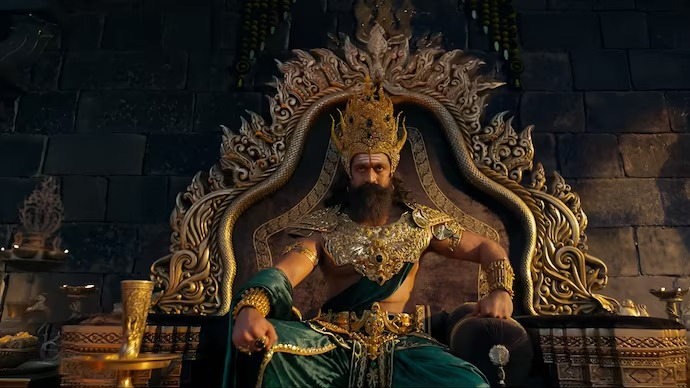
Ramesh stated that he joined the team of ‘Ramayana: Rise of a Legend’ in February 2024. In reality, however, the construction of the sets began in April at Prime Focus Studios, located in Mumbai’s Film City. More than 150 sets were built for the film. The preparation of a set is rarely finalized in the first attempt; often, 10 to 15 different versions or variations must be created before arriving at the final design seen on screen. The actual construction of the sets commenced after about three months of preparatory work. One of the most striking elements in the film is Ravana’s throne. The primary objective was to design a throne that would effectively reflect Ravana’s life and personality. Notably, this was not created using VFX. First, a clay model of the throne was crafted, followed by the development of modules, and finally, the throne was given its definitive shape using fiber. The most notable aspect was the gold craftsmanship. The throne was given its final look using a layer of 24-carat gold; its construction took four months and cost approximately 1 crore. A similar level of effort and expenditure went into creating Ravana’s ornaments. Tarang Arora, Creative Head of ‘House of Amrapali’, stated that Lanka is believed to have been a ‘golden city’—a place of immense luxury and opulence—and it was essential to depict this on screen. Crafting the chest plate worn by Ravana in the film was the most complex task; artisans created the entire piece by hand, a process that required a significant amount of time to complete. Special attention was also paid to ensuring that Ravana (played by Yash) could remain comfortable for over six hours while wearing heavy ornaments and costumes. To depict Ravana as an ardent devotee of Lord Shiva, serpent motifs were incorporated into his jewelry. Furthermore, the producers spent over 1.5 crore rupees on the construction of Shurpanakha’s chariot, a process that took 90 days to complete.