
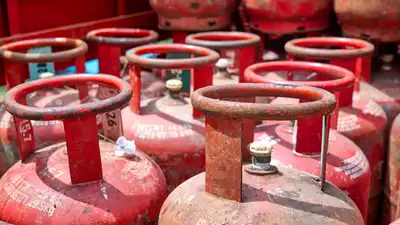
Following the end of the Iran-US war and the opening of the Strait of Hormuz, state-owned oil and gas marketing companies on Wednesday, July 1, reduced the price of commercial LPG cylinders by Rs 183.5 and aircraft turbine fuel (ATF) by Rs 5 per litre. During the Middle East tensions, the prices of commercial LPG and crude oil had risen to record levels globally. Now, with the end of the war and the opening of the Strait of Hormuz, these prices have started to decline.
Both commercial LPG and ATF are regulated fuels. Their prices are revised on the first of every month based on international standards. During the Iran-US war, their prices in India had increased fourfold. During this period, the price of commercial LPG per cylinder had increased by Rs 1373. Currently, the price of a 19 kg commercial LPG cylinder in Delhi has been reduced by Rs 183.5 to Rs 2,930. In Mumbai, it is Rs 2,884, in Kolkata Rs 3,072 and in Chennai Rs 3,099.5.
There has been no reduction in the price of domestic LPG cylinders:
State-owned oil and gas marketing companies have also reduced the price of 5 kg Free Trade LPG (FTL) cylinders. These cylinders are mainly used by migrant workers, street vendors. The price of this cylinder has also been reduced by Rs 13, making it now Rs 808.5. However, the price of 14.2 kg domestic LPG cylinder has remained unchanged, i.e. it is now priced at around Rs 942. However, in view of the fall in the price of commercial free-trade LPG, the price of domestic gas cylinders is also expected to fall this month.
Domestic gas cylinder prices to fall in July:
War over, Hormuz open: After the Iran-US war, the Hormuz system has been opened. Gas and oil ships stranded at sea have resumed their movement once again. India also imports a significant amount of its LPG and oil through this route. Now, the pressure on the supply chain has eased. In view of this, the Indian government last week lifted the ban on commercial LPG consumption and allowed its earlier use. As a result, the price of domestic LPG cylinders may come down in the future due to the abundant availability of LPG.
Commercial gas cylinder prices fall: The rise and fall in commercial gas cylinder prices reflect the trend in the international LPG market and import costs. A fall in commercial cylinder prices could indicate a reduction in pressure in the global LPG market. Consequently, a fall in international LPG prices could have a knock-on effect on domestic gas prices in India.
LPG imports from the US: India’s state-owned oil companies (IOC, HPCL and BPCL) have signed an agreement to import 2.2 million tonnes of LPG annually from the US by 2025. A report obtained by Reuters, from Kepler, has shown that India’s LPG imports from the US are expected to cross a record 1 million tonnes in June 2026.
In May 2026, India imported 6,48,300 tonnes of LPG from the US. This clearly means that the US will continue to import LPG as per India’s agreement. Moreover, the opening of the Strait of Hormuz has improved LPG imports from the Gulf cities. As a result, domestic gas prices are likely to fall rather than rise due to ample availability of LPG in the country.
Qatar’s LPG Supply: Qatar is one of the world’s leading gas and LPG exporters. India also imports a significant amount of energy from Qatar. Even during the Iran-US war, Qatar took steps to ensure uninterrupted energy supply to India. During this period, Qatar used to transport LPG-laden ships to Gujarat’s Kandla and Mundra ports through safe routes. However, with the Strait of Hormuz now open, India’s import costs and supply risks are likely to come down. This impact could also be reflected in the domestic LPG cylinder prices.
Use of electrical cooking appliances: Electricity demand in India has increased rapidly. According to a report published in Down to Earth, in 2026, peak electricity demand increased rapidly from 1 April to 257.1 GW on 25 April, from 214.9 GW on 25 April. It then reached a record high of 270.8 GW on 21 May 2026. In just 50 days, electricity demand increased by 26 percent. Meanwhile, in 2025, India’s electricity demand reached a peak of 242.49 GW. This means that peak demand has increased by about 28 GW compared to the previous year.
The use of electronic cooking appliances such as induction cookers and air fryers is also a significant reason for the increase in electricity demand in India. According to a survey conducted by a private agency, about 5 percent of Indian households use some form of electric cooking appliance.
If we assume that India’s population is about 1.47 billion, with five members in each household, then the total number of households in the country will be 310 million. If we consider these 31