
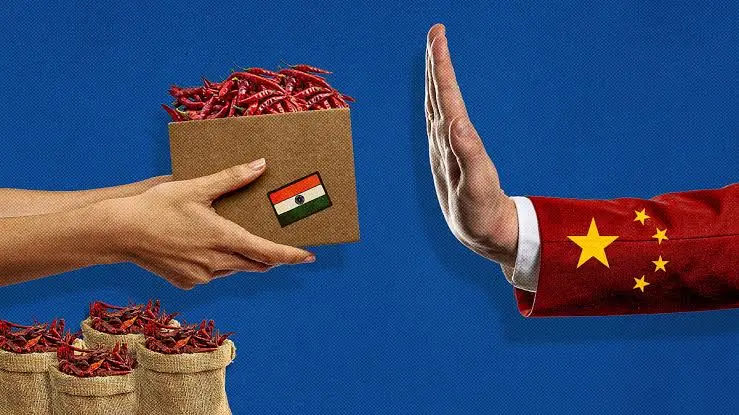
India is facing a major bilateral trade barrier. While the approach of its enemy China is being understood, now a decision by its best friend Japan has become a cause of great concern for India. According to recent reports, while China has imposed restrictions on Indian chillies, Japan has imposed a ban on the import of Indian mangoes. This is said to be a strong blow to the Indian agricultural export sector.
Why did China and Japan impose restrictions?
Pesticide found in chillies: After a large amount of pesticide called ‘Methamidophos’ was found in chillies sent from India, the Chinese customs department has stopped it. This pesticide causes diseases related to the nervous system. Earlier, China has also rejected 70 consignments of non-basmati rice from India.
Indian mango plant flaw: On the other hand, Japan has imposed a ban on Indian mangoes for the second time in the last four decades. This action was taken after a Japanese inspection team found major flaws in the ‘fumigation’ process at the Indian plant. It is worth noting that earlier in 1986, Japan had imposed a ban on Indian mangoes for about 20 years due to ‘fruit-fly’ infection, which was later lifted in 2006. Now the same problem has arisen again.
Farmers and exporters seek government intervention:
After this crisis, the Andhra Pradesh mango exporters and mango farmers’ association have sought intervention from both the state and central governments. They have demanded a ban on the use of harmful chemicals in the agricultural sector and awareness creation among farmers. According to the ‘Federation of Indian Spice Stakeholders’, the rate of rejection of Indian products in foreign markets has increased from 5% to 20%.
The controversy started in Singapore, Hong Kong:
In early 2024, Hong Kong and Singapore withdrew some spices from the market after ‘ethylene oxide’ was found in some spices of famous Indian spice brands ‘MDH’ and ‘Everest’. According to the WHO’s cancer research agency, ethylene oxide is a carcinogenic substance. After this, about 5 major countries of the world have imposed restrictions on Indian spices.
Lack of inspection in the domestic market:
Surprisingly, the ethylene oxide for which Indian spices are banned abroad is not regularly checked in spices sold in the Indian domestic market. While there are strict rules for foreign countries, there is no such system for domestic consumers. According to the Centre for Science and Environment, most government laboratories in India do not have modern equipment such as gas chromatography and mass spectrometry to test pesticides in spices and agricultural products. As a result, samples have to be sent to private labs and the reports take a long time to come. According to a report by the Pesticide Action Network, the level of pesticides in food products is increasing year by year.
Global Trade and India’s Goals:
Despite having the second largest arable land area in the world, India’s share in global agricultural trade is only 2.2% to 2.4%, or about $50 billion. India’s agricultural exports have increased from $34.5 billion in 2019-20 to $51.1 billion in 2024-25. In such a situation, if quality is questioned internationally, then India’s credibility in the global market is likely to decline. Experts have expressed the view that the government needs to urgently strengthen the framework for compliance.