
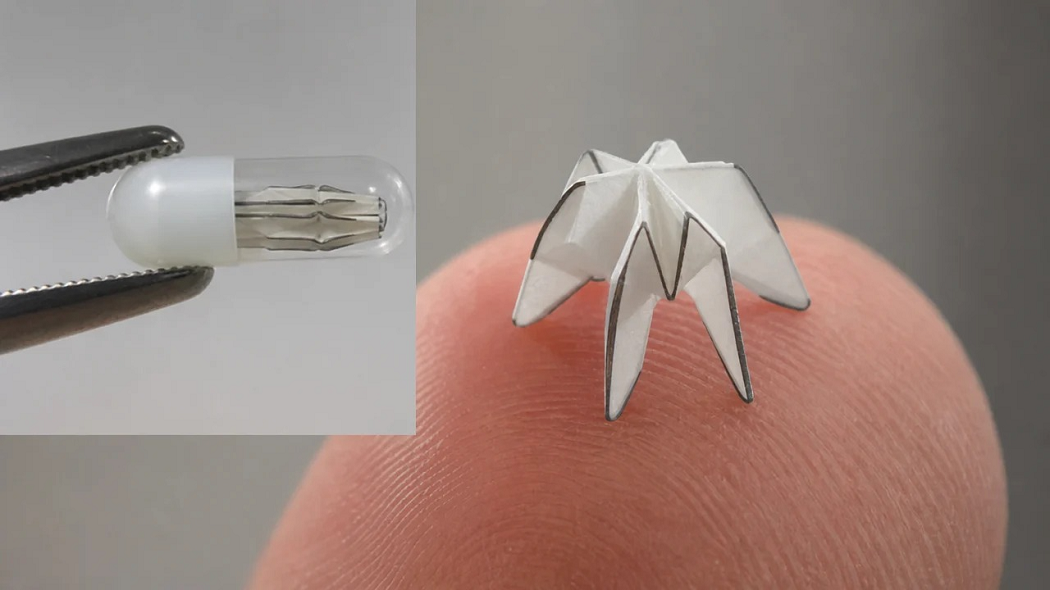
Imagine a flat piece of plastic placed on a hot surface and it automatically transforms into a fully functional robot. It requires no human intervention, motors, or complicated connections. It may sound fantastical, but researchers at the Massachusetts Institute of Technology (MIT) have done just that with a tiny origami-inspired robot. It can transform into a robot on its own and perform the required tasks. The centimeter-long machine, unveiled in 2015, shows how a combination of simple tools, clever engineering, and the ancient art of origami can create a new generation of tiny robots.
Although it is an experimental prototype, the project offers a glimpse of a future where self-assembling robots could help in medical care, disasters, and other situations where traditional machines are at risk. Developed by MIT’s Computer Science and Artificial Intelligence Laboratory, the robot starts as a flat structure with three arms. The middle arm is made of polyvinyl chloride, a plastic that reacts to heat.
The top and bottom arms, on the other hand, are made of laser-cut pieces that control the breaking process. When heated to about 65 degrees Celsius, the PVC arms of the structure shrink and twist on their own, transforming into a 3-D robot in about a minute. It is a tiny robot, measuring 1.7 cm long and weighing just 0.31 grams. Despite its small size, the robot can walk, climb, swim in water, and carry twice its own weight. Researchers are hopeful that future versions of this will perform complex tasks inside the human body in medical applications.