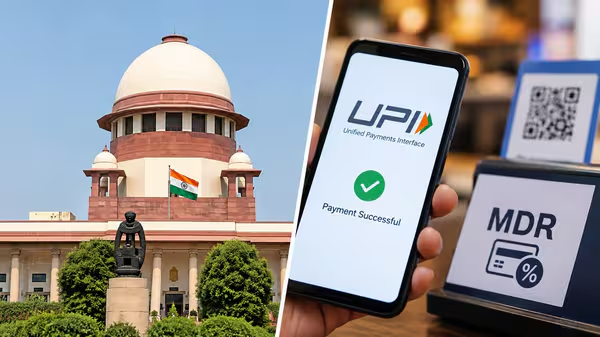
Making payments at shops by scanning a QR code—allowing one to purchase goods without worrying about carrying cash or loose change—has become a common practice today. But who has been bearing the cost of the UPI service, which we have long perceived as being completely free? Will shopkeepers be required to pay a charge on every large UPI transaction in the future? On November 5th, the Central Government presented its clear stance on this matter before the Supreme Court, stating explicitly that no promise was ever made to keep UPI free of charge indefinitely. Directives Regarding MDR (Merchant Discount Rate):
In September 2026, the National Payments Corporation of India (NPCI)—an organization under the Central Government—issued a directive to impose an MDR (Merchant Discount Rate) on merchant UPI transactions exceeding ₹2,000. Subsequently, the matter reached the Supreme Court. The government has now defended its decision in court, stating that thousands of crores of rupees are being spent to operate, secure, and develop the UPI ecosystem. Given this, it is not feasible to keep every transaction free of charge indefinitely.
What is MDR, and from whom will it be collected? Suppose you purchase goods worth ₹5,000 from a shop and make the payment via UPI. While ₹5,000 will be deducted from your account, a portion will be withheld from the amount received by the shopkeeper to cover payment processing costs. This charge is known as the Merchant Discount Rate (MDR). It is not collected directly from the customer; instead, it is deducted from the merchant’s account during the payment settlement process. These funds are distributed among the banks and other service providers involved in the payment system. The NPCI had intended to implement this starting October 15, 2026, but for the time being, this charge has not been imposed. Petition Filed in the Supreme Court:
Some individuals filed a Public Interest Litigation (PIL) in the Supreme Court regarding this matter. According to reports, the Central Government submitted its response to the Supreme Court on November 5th. In its defense, the government stated that the new framework had been under consideration for some time and was finalized only after consultations with various stakeholders. The government further clarified that merchants were never given any guarantee that processing fees for UPI transactions would always remain zero. The subsidies provided until now were also contingent upon the government’s discretion; there was no legal obligation to provide them. Different Policies for Small and Large Businesses:
The government has further stated that while Article 14 of the Constitution guarantees the right to equality, this does not imply that the same provisions must apply to every type of transaction. The circumstances of small and large businesses differ. By keeping transactions of up to ₹2,000 free of charges, relief has been provided to ordinary consumers and small businesses. Conversely, charges will be levied on businesses engaging in large-value transactions. According to the government, it has provided ₹8,730 crore to banks between the years 2021-22 and 2024-25 to maintain the ‘zero MDR’ (Merchant Discount Rate) regime. However, it is not sustainable in the long run to cover the costs of the entire system solely through government subsidies. A major question in this entire matter is whether merchants will pass the burden of these charges on to the customers. Although the government has stated that recovering the MDR (Merchant Discount Rate) from customers is not permitted, it is necessary to consider how feasible this actually is in practice.